




Walida’s Chains, Ese’s Freedom: A Tale of Two Abductions and the Selective Outrage That Shames Us All
By Haruna Abubakar Bebeji
The year is 2026. A decade after the nation’s collective conscience was pricked by the plight of Ese Oruru, a 13-year-old Christian girl abducted from Bayelsa and taken to Kano, history has repeated itself with a cruel and revealing twist. But this time, the victim is a Muslim girl, the alleged perpetrator is a Christian, and the silence from certain quarters is deafening.
This is the story of Walida Abdulhadi Ibrahim, a young woman from Hadejia, Jigawa State, whose life has been turned into a battleground for justice, institutional bias, and the dangerous double standards that continue to plague our nation.
The Ordeal of Walida Abdulhadi
According to her distraught father, Malam Abdulhadi Ibrahim, Walida went missing in 2023 at the age of 16. For two years, the family searched in vain, a period of anguish so profound that it contributed to the death of Walida’s mother, who passed away without knowing her daughter’s fate .
Their nightmare took a new turn in December 2025 when Malam Ibrahim received a call from a man in Abuja: a Department of State Services (DSS) operative named Ifeanyi Onyewuenyi. The officer reportedly informed him that Walida was with him, had given birth to his child via Caesarean section, and had been converted to Christianity. He stated his intention to marry her.
The family’s legal team, Gamji Lawchain, petitioned the court, leading a Magistrate Court in Hadejia to order Onyewuenyi’s arrest and Walida’s immediate release to her parents . Yet, months later, Walida remains in what the DSS describes as “protective custody” at its Abuja headquarters, a decision the agency claims is based on her fear of being harmed by her family if she returns.
While the DSS has arrested Onyewuenyi and assured the public of an investigation, Muslim rights groups, including MURIC, FOMWAN, and Women in Da’awah, have rejected the security agency’s narrative . They point to the magistrate’s order, Walida’s age at the time of her disappearance, and the alleged forced conversion as evidence of a grave injustice. They argue that a security agency cannot be the investigator, the custodian, and the judge in a case involving its own operative, calling the situation a “cover-up”.
The Ghost of Ese Oruru and the Hypocrisy of the Media
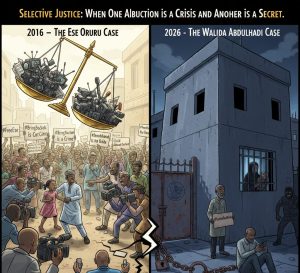
It is impossible to discuss Walida’s case without recalling the 2016 saga of Ese Oruru. Ese was allegedly abducted by Yunusa “Yellow” Dahiru, forcibly converted to Islam, and taken to Kano. That story sparked a national uproar. The hashtag #FreeEse trended for weeks. The media gave it saturation coverage. Civil society groups, human rights activists, and Christian associations held protests. The Emir of Kano was drawn into the controversy, and the federal government intervened. Ultimately, Yunusa was arrested, convicted, and sentenced to 26 years in prison (later reduced on appeal).
The contrast with Walida’s case is as stark as it is shameful. Where is the #FreeWalida movement? Where is the sustained media scrutiny? Where is the outrage from the same voices that demanded justice for Ese?
Public affairs analyst Yushau A. Shuaib captured this national hypocrisy perfectly. In a recent piece, he asked, “Nearly a decade ago, Nigeria erupted over the abduction and alleged forced conversion of Ese Oruru… Today, a Muslim girl is alleged to have been abducted, raped, and forcibly converted to Christianity by a state security operative. Will this case attract the same volume of condemnation? The same moral panic?” .
The answer, so far, has been a resounding and disappointing “No.” The muted reaction suggests that in Nigeria, justice is not blind. It appears to wear the lens of the victim’s religion. When the victim is Christian and the alleged perpetrator Muslim, it is a national crisis. When the roles are reversed, it is treated as a complex case requiring “protective custody” and further study.
The Battle for the Truth
The DSS and its allies have attempted to muddy the waters by presenting Walida as an adult who acted of her own free will. A narrative has been pushed that she is 22 years old, that she left home voluntarily after being “tapped” by a woman named Maryam, and that she fears returning to her family.
However, this narrative crumbles under scrutiny. Walida’s father insists she was born in 2008, meaning she was 15 when she disappeared and is now only 18 . Her uncle, Badamasi Ibrahim, vehemently denies that the family would harm her, stating, “We are not non-believers who would kill their child” . Furthermore, human rights lawyer Hamza Nuhu Dantani has petitioned the DSS, exposing what he calls a “scripted interview” designed to protect the suspect. He points to the undeniable fact that Walida gave birth in 2025, meaning she was impregnated in 2024 while still legally a minor.
Is Walida’s current testimony the voice of a free woman, or is it the voice of trauma, coercion, and Stockholm syndrome, carefully curated by the very institution holding her captive? This is a question that demands an independent investigation, not an internal DSS panel.
A Call to the Conscience of Nigeria
This case is not just about Walida Abdulhadi. It is about the soul of our nation. It tests whether the “rule of law” applies equally to all or is just a convenient slogan. It exposes how power can be abused when worn in uniform, and how institutions can close ranks to protect their own.
To our Muslim brothers and sisters across Nigeria, this is your moment. Do not let the silence of others silence you. Your daughter has been taken. Your sister has been violated. Your faith has been assaulted under the guise of conversion. The pain of the Ummah must be made visible and vocal.
To all Nigerians of conscience—Christian, Muslim, or otherwise—we must reject this selective empathy. A crime against one child is a crime against all children. The pain of a father in Hadejia is no less valid than the pain of a father in Yenagoa.
We call on the DSS to immediately comply with the court order and release Walida to her family or a neutral third party, such as NAPTIP or the Federal Ministry of Women Affairs . We demand that the investigation be transferred to an independent body free from institutional conflict of interest. We call on the Jigawa State Governor and the Nigerian government to intervene and ensure that justice is not a commodity reserved for a privileged few.
Ten years ago, we said “Never Again” after Ese Oruru. Today, Walida Abdulhadi stands in chains, asking if we meant it. Let us answer her not with silence, but with a roar for justice.
#JusticeForWalida
#FreeWalida
#WhereIsTheOutrage